Back to Cape Breton with Regrets and Renewal
SpeciaLink: The National Centre for Early Childhood Inclusion has returned to its roots in Cape Breton, Nova Scotia, after a three-year term in Winnipeg. With great regret but also with a sense of commitment and purpose, the returning Cape Breton Executive Committee and Executive Director, Dr. Sharon Hope Irwin, welcome the opportunity to move ahead on the SpeciaLink mission to “Expand the quality and quantity of early childhood inclusion.”
As Dr. Sharon Hope Irwin says: “Debra Mayer has brought her incredible skills to SpeciaLink, securing a recognizable brand to the materials, further developing the range of programs that have had training in the tools, strengthening connections with training institutions and services across Canada, and strengthening involvement of members, board and executive committee. Thanks to Debra Mayer, we’ve entered the 2nd decade of the 21st century more visible than ever. I wish Debra all the best in her new positions and hope that she will still be able to work with SpeciaLink on our journey toward a fully inclusive early childhood world.”
Your membership support is more important than ever, and all memberships and resource orders will be handled by Sharon and Breton Books in Sydney Nova Scotia. Contact Sharon via email. specialink@ns.sympatico.ca
SpeciaLink Early Childhood Inclusion Quality Scale
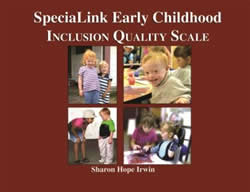 The SpeciaLink Early Childhood Inclusion Quality Scale (2009), by Dr. Sharon Hope Irwin. The SpeciaLink Early Childhood Inclusion Quality Scale (2009), by Dr. Sharon Hope Irwin.
This workbook is a tool for assessing inclusion quality in early childhood centres and for helping centre move toward higher quality inclusion. The Scale provides a picture of sustainable and evolving inclusion quality—an emerging issue as more children with special needs attend communitybased centres and as inclusion pioneers leave their centres and a new generation of directors and early childhood educators take on the inclusion challenges. Read more/order »
Assessing Inclusion Quality report
Assessing Inclusion Quality in Early Learning and Child Care In Canada with the SpeciaLink Child Care Inclusion Practices Profile and Principles Scale. [PDF 64pp 600KB].
A report prepared for the Canadian Council on Learning. by Donna S. Lero, Ph.D., Jarislowsky Chair in Families and Work Centre for Families, Work and Well-Being, University of Guelph, February, 2010.
"Disability and Inclusion: changing attitudes-changing policy"
This chapter by Debra Mayer appears in the recently published Beyond Child’s Play: Caring for and educating young children in Canada Our Schools/ Our Selves, Spring 2009 (vol. 18, no. 3, #95) published by the Canadian Centre for Policy Alternatives, Ottawa.
"As we move towards the end of the first decade of the 21 st century, Canadian families continue to be stymied by the lack of a national early learning and care system, and policy makers continue to be confounded by the concept of a “rights based” rationale for children’s entitlement to early learning services separate from their parents employment status."
Read the full chapter: Disability and Inclusion: changing attitudes-changing policy [PDF 7pp 82KB].
Inclusion training: SpeciaLink on the Road
If you have not yet taken part in our inclusion training, please visit SpeciaLink on the Road, to find out where we are offering training next.
SpeciaLink: The National Centre for Child Care Inclusion
76 Cottage Road,
Sydney, NS B1P 2C7
Phone (902) 539-3817
1-800-565-5140
FAX (902) 539-9117
specialink@ns.sympatico.ca
© 2004-2019 SpeciaLink. All rights reserved.
Site maintenance by [design by Billie Carroll] |




.jpg)